ALPHAROMEO15 / FIELD REFERENCE DIVISIONTHE GUN BENCH · VOL. 01MAINTAIN / PRESERVE / RESPECT
WORKSHOP FILES // GUN CARE & LIGHT MAINTENANCE

The Gun
BenchCARE IS A DISCIPLINE.

From AR-platform rifles to historic Garands, 1911s, wheelguns, field shotguns and hunting rifles: an organized bench notebook for keeping metal clean, finishes protected and routine maintenance sensible.

AFTER ACTION / THE CLEANING BENCH
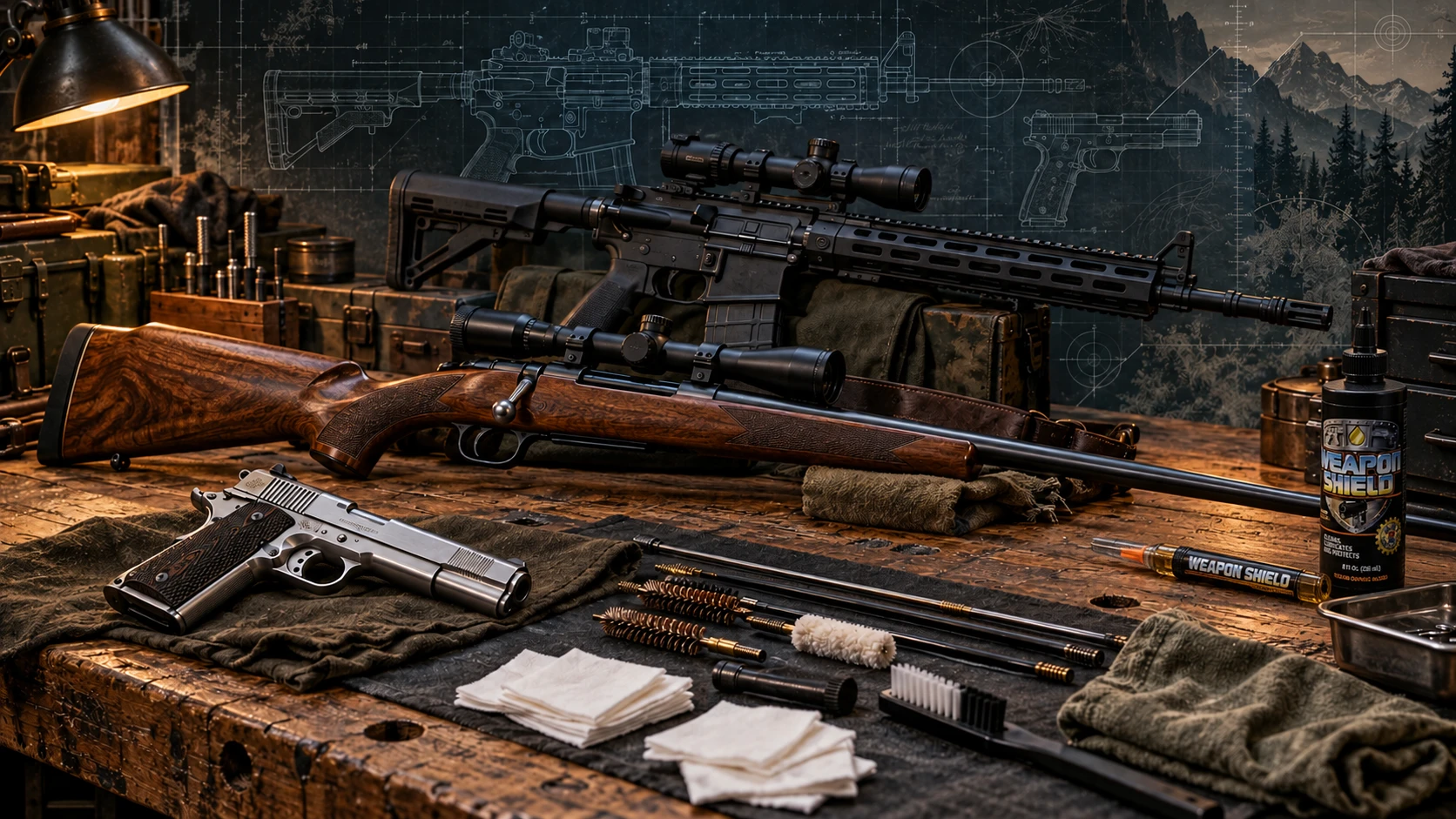
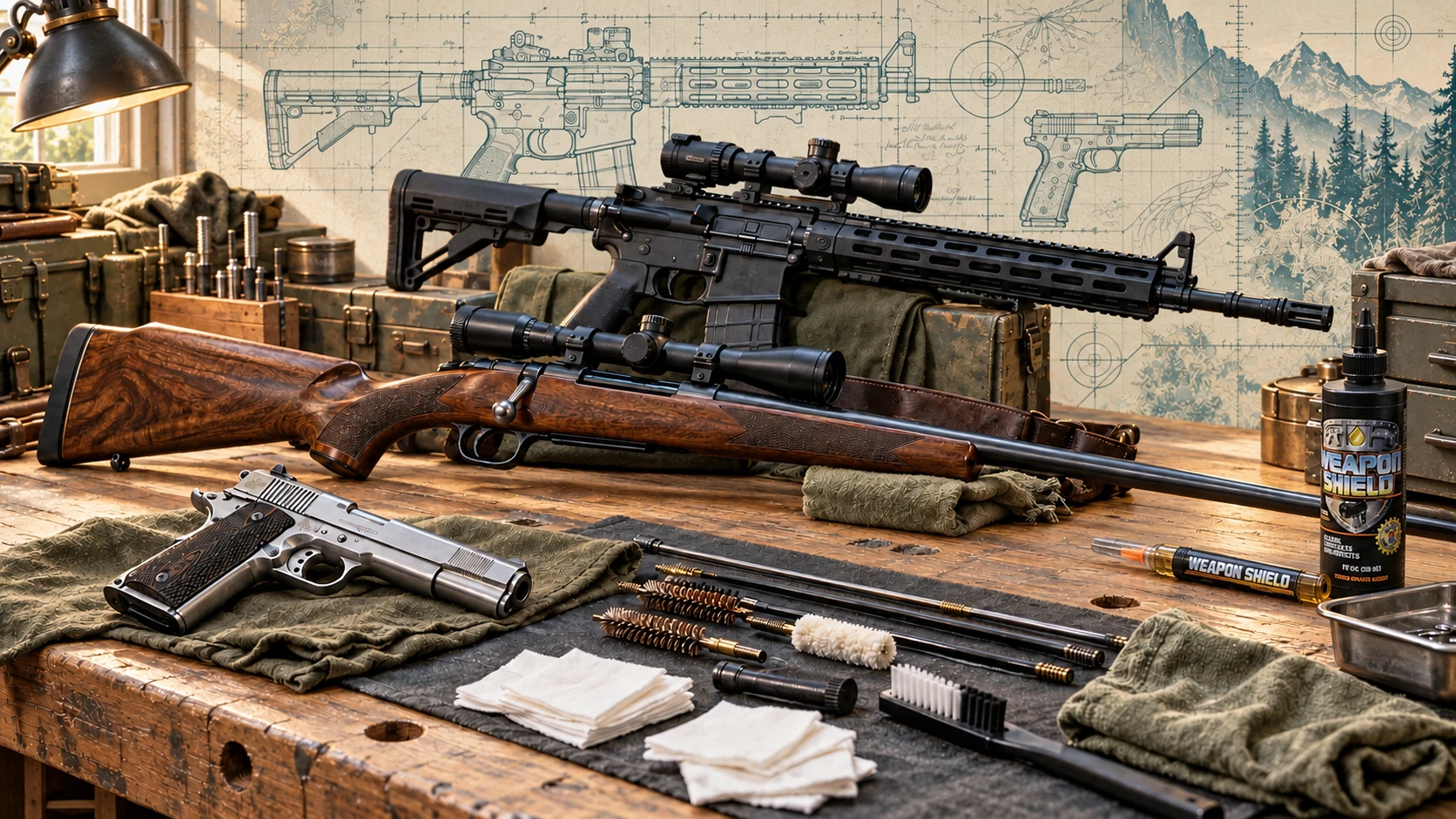
Firearms, cleaning rods, brushes and Weapon Shield supplies on a warmly lit workbench with blueprint graphics.The same gun care workbench in daylight with parchment and teal blueprint graphics.
FIG. 01 / THE GUN BENCH
ALWAYS UNLOAD AND VERIFY CLEAR · KEEP AMMUNITION OFF THE BENCH · FOLLOW THE EXACT OWNER’S MANUAL · NO LIVE-AMMO FUNCTION TESTS
REFERENCE FILES ONLINE
01 / IDENTIFYFind the platform and its peculiarities
02 / CAREClean and protect only what is specified
03 / PRESERVEStore correctly and record concerns
READ BEFORE ANY MAINTENANCE

These are general reference notes, not gunsmithing or model-specific disassembly instructions. Check the exact manufacturer’s manual. If parts are cracked, the action behaves unusually, or a safety check is uncertain, stop and consult a qualified gunsmith.

BENCH SUPPLIES / THE EVERYDAY TRIO

One bench. Three distinct jobs.

Good gun care is about using the right amount of the right product—not soaking every surface.

01
CLEAN · LUBRICATE · PROTECT

WEAPON SHIELD CLP

Daily bench staple for routine residue removal, light lubrication and corrosion protection. Use a thin film and remove the excess.

Everyday wipe-down / prescribed bearing points
READ CARE NOTES ↗

02
TARGETED DEEP CLEAN

WEAPON SHIELD SOLVENT

For stubborn carbon, copper and lead fouling when material and finish compatibility permit. Complete the proper protect-and-lube step afterward.

Bore patches / persistent fouling
READ CARE NOTES ↗
03
CONTROLLED CONTACT FILM

WEAPON SHIELD GREASE

A precision-applied lubricant for specific metal bearing points requiring grease—especially a useful fit for Garand-style service guidance.

Garand contact points / specified hinges
READ CARE NOTES ↗
Featured bench products: Weapon Shield CLP, Solvent and Grease. These recommendations describe their intended roles; always check the product label, current SDS and firearm manual. Product information is educational; no manufacturer store links appear on this page.
OPEN BENCH / MEMBER-TO-MEMBER DISCUSSION

Take it to the forums.

The reference files are the starting point. The best bench talk happens with fellow members.

DISPATCH 07 / THE COMMUNITY WORKSHOP

Have a question? Pull up a chair.

Share what you're cleaning, ask about a stubborn issue, or compare notes with other owners. These links open the real forum discussions.

CLEANING / SOLVENTS / CORROSION

The Cleaning Station

Cleaning questions, product experiences, bore care, stubborn fouling and preserving a favorite firearm. From beginners to collectors.

DISCUSS GUN CLEANING
LIGHT MAINTENANCE / BUILDS / TROUBLESHOOTING

The Armorer's Work Bench

Talk routine upkeep, fit and finish, build questions and when a problem is better handed to a qualified gunsmith.

ASK THE ARMORERS
REFERENCE DRAWER A // FIREARM FAMILIES

Platform dossiers

Open a file for care priorities, cleaning notes, lubrication choices and warning signs.

FILE01
MODERN RIFLE

AR-15 & modern sporting rifles

A disciplined, light-touch routine for direct-impingement and piston variants.

⌁ LINK TO FILEINSPECT / CLEAN / PROTECT
OPEN MAINTENANCE NOTES

01 Inspect

  • With the firearm safely unloaded, look for loose accessories, unusual wear, rust, and debris at accessible surfaces. Follow the specific maker’s field-strip instructions; AR-pattern rifles are not all identical.
  • Pay particular attention to the chamber, bore, visible bolt/carrier surfaces, magazine well, and accessible receiver areas. Preserve seals and optics rather than spraying chemicals indiscriminately.

02 Clean

  • Use caliber-appropriate patches and a bore guide where specified; protect the chamber and muzzle crown. Wipe accessible carbon deposits without scraping coatings or forcing tools into small openings.
  • Remove grime and excess product from accessible receiver and bolt-carrier surfaces. Avoid pouring cleaner into the gas tube, gas block, or other enclosed gas-system parts; seek your model manual for service intervals.

03 Protect

  • Apply a small amount of suitable CLP to the metal surfaces and manufacturer-designated bearing areas. Some AR platforms require a wet-looking film at designated points, but the amount and locations are model-specific.
  • Do not fill the chamber, bore, magazine, or firing-pin channel with oil. Inspect and clear any preservative from the bore/chamber before use as directed by the manual.

BENCH NOTE: Routine CLP is the first choice for accessible wipe-downs; reserve the Solvent for persistent fouling. Grease only if the rifle’s own manual calls for it.

STOP & REFER: Cracked parts, damaged gas-system components, abnormal wear, recurring feeding/extraction trouble, or uncertainty about reassembly belong with a qualified armorer.

Reference: Firearm-specific owner manual; NSSF firearm-safety guidance.
FILE02
HERITAGE RIFLE

M1 Garand

Traditional wood, steel and distinctly grease-oriented wear surfaces.

⌁ LINK TO FILEINSPECT / CLEAN / PROTECT
OPEN MAINTENANCE NOTES

01 Inspect

  • Verify the rifle is unloaded, including chamber and en-bloc clip area, before work. Check exposed steel for corrosion and look for stock cracks, swollen wood, loose hardware, or signs of unusual wear.
  • Older rifles have varied service histories. Preserve original markings and finishes; avoid abrasive “restoration” during ordinary cleaning.

02 Clean

  • Use an appropriate bore cleaner and patches per the M1 manual, keeping chemical runoff off oil-finished wood. Clean the chamber with the appropriate manufacturer-approved tools.
  • Wipe dirt and old residue from accessible metal surfaces. Do not soak the stock or use aggressive solvents on vintage wood.

03 Protect

  • Unlike many modern designs, the M1 commonly calls for grease on selected high-load metal-to-metal contact surfaces. Follow the M1-specific maintenance drawings rather than greasing the entire action.
  • Lightly preserve exposed steel while keeping the bore/chamber and wood treatment consistent with the appropriate manual. Do not pack grease into the gas system.

BENCH NOTE: Weapon Shield Grease is the natural bench companion for prescribed Garand bearing surfaces; CLP suits light corrosion protection, and Solvent assists with stubborn deposits.

STOP & REFER: Excessive operating-rod drag, cracked stock, questionable headspace, worn locking surfaces, or unknown service history merits specialist inspection.

Reference: U.S. Army TACOM M1 Garand Operation and Maintenance Guide; CMP resources.
FILE03
CLASSIC PISTOL

1911-pattern pistols

Steel-slide classics where small amounts in the right places matter.

⌁ LINK TO FILEINSPECT / CLEAN / PROTECT
OPEN MAINTENANCE NOTES

01 Inspect

  • After unloading and verifying the chamber and magazine well, inspect accessible slide, frame, barrel exterior, sights and grip panels for rust or unusual wear.
  • Follow the exact model’s field-strip instructions. A modern tightly fitted 1911 and a vintage service pistol may have differing requirements.

02 Clean

  • Use correctly sized bore patches and a finish-safe solvent when necessary. Gently wipe carbon from accessible slide/frame surfaces; avoid abrasive polishing and altering fitted parts.
  • Keep cleaning chemicals off vulnerable grip materials, painted sight marks and finish-sensitive surfaces.

03 Protect

  • A very small amount of recommended lubricant on the manufacturer-designated slide/frame bearing surfaces is preferable to flooding the mechanism.
  • Keep firing-pin passages, ammunition and magazines free of excess lubricant; follow the maker’s instructions on rails, barrel contact areas and storage.

BENCH NOTE: CLP for routine wiping and corrosion protection. Grease may be appropriate on specified slide contact areas if the manufacturer approves it; less is more.

STOP & REFER: Hammer follow, abnormal safety behavior, cracked parts, persistent stoppages, or evidence of altered fire-control parts calls for a qualified 1911 gunsmith.

Reference: Model-specific Colt, Springfield Armory, or other 1911 maker’s owner manual.
FILE04
WHEELGUN

Double- & single-action revolvers

Cylinder faces, chambers and the spaces where residue collects.

⌁ LINK TO FILEINSPECT / CLEAN / PROTECT
OPEN MAINTENANCE NOTES

01 Inspect

  • Verify all chambers are empty. Inspect the cylinder face, chambers, forcing-cone exterior and accessible frame surfaces for lead, soot or corrosion.
  • Notice unusual cylinder drag, visible damage, or changes in the way the action feels; do not adjust timing or lockwork as routine care.

02 Clean

  • Use chamber-size patches and a nylon brush when appropriate for visible residue. Gently clean around the ejector star or accessible extractor area per the maker’s instructions.
  • Avoid aggressive abrasives on blued, plated, or collectible finishes. Do not flood enclosed action parts with solvent.

03 Protect

  • Wipe exposed steel with a thin film of corrosion inhibitor. Lubricate only indicated points, and wipe off any excess that could attract lint or migrate into ammunition.
  • Keep grips and delicate finishes protected from chemical runoff.

BENCH NOTE: A CLP-dampened cloth covers much routine exterior care; Solvent is for resistant powder or lead deposits when finish compatibility permits.

STOP & REFER: Out-of-time cylinder, excessive endshake, damaged forcing cone, or poor lockup needs a revolver specialist rather than a home adjustment.

Reference: Ruger revolver manuals and Ruger revolver cleaning videos.
FILE05
MODERN PISTOL

Striker-fired & other semiauto pistols

Modern polymer, alloy and steel-frame service pistols.

⌁ LINK TO FILEINSPECT / CLEAN / PROTECT
OPEN MAINTENANCE NOTES

01 Inspect

  • Confirm the chamber and magazine are empty before any handling. Follow the specific model manual for a safe field strip.
  • Check accessible slide, barrel, recoil assembly exterior, rails and frame for corrosion, cracks, grit or irregular wear.

02 Clean

  • Use appropriate patches on the bore and gently wipe accessible carbon and old lubricant. Use polymer-safe products and avoid chemical contact with sight inserts.
  • Keep striker or firing-pin channels and magazines free of excess oil and debris unless the manufacturer specifies otherwise.

03 Protect

  • Apply only the small manufacturer-specified drops or film of lubricant to designated contact surfaces. Excess lubrication can cause performance problems.
  • Recheck the owner’s manual for any model-specific dry or lightly coated areas.

BENCH NOTE: Weapon Shield CLP works as a routine cleaner/protectant where material compatibility and the pistol manual allow it.

STOP & REFER: Chipped locking surfaces, abnormal wear, damaged striker/firing-pin components, or repeated stoppages call for the manufacturer or certified armorer.

Reference: GLOCK “Caring for Your GLOCK”; Smith & Wesson safety and maintenance guidance.
FILE06
FIELD SHOTGUN

Pump-action shotguns

Receivers, chambers and magazine areas exposed to field grit.

⌁ LINK TO FILEINSPECT / CLEAN / PROTECT
OPEN MAINTENANCE NOTES

01 Inspect

  • Verify the chamber and magazine tube are empty according to the shotgun’s manual. Check exterior metal, action bars (where visible), furniture, and accessible chamber area for wear or damage.
  • After a wet hunt, look for moisture under sling points and in other accessible recesses.

02 Clean

  • Clean the bore and chamber using shotgun-gauge-correct tools; pay attention to plastic wad residue and powder fouling.
  • Use patches or a non-marring brush on accessible action surfaces and wipe residue out of reachable areas without taking apart components beyond the manual.

03 Protect

  • Apply a light protective film to exposed steel and precisely to any action surfaces the maker identifies. Remove excess oil that might migrate into the stock or shell storage areas.
  • Inspect the manual for choke-tube care. Do not force stuck choke tubes; consult a gunsmith.

BENCH NOTE: CLP for wipe-downs after the range or a wet hunt; Solvent where plastic wad or carbon fouling resists routine patches.

STOP & REFER: Sticky action, damaged shell stops, feed problems, cracking furniture, or a stuck choke are reasons to stop and have the firearm examined.

Reference: Mossberg 500/590 owner manual; Winchester shotgun manuals.
FILE07
FIELD SHOTGUN

Semiautomatic shotguns

Gas-operated and inertia-operated designs require different care.

⌁ LINK TO FILEINSPECT / CLEAN / PROTECT
OPEN MAINTENANCE NOTES

01 Inspect

  • Confirm the chamber and all magazine locations are empty. Determine whether the shotgun is gas- or inertia-operated using the model manual.
  • Inspect accessible gas-system or bolt surfaces as the manual directs; do not assume the same maintenance intervals apply to both systems.

02 Clean

  • Wipe breech and accessible receiver residue; use gauge-correct bore and chamber patches. Gas-operated designs may need specific piston-system service according to their own instructions.
  • Keep grease, harsh cleaners, or heavy oil away from parts identified as dry-running by the manufacturer.

03 Protect

  • Oil only the specified surfaces in small amounts. Excess product can trap unburned powder and field grit.
  • Keep the exterior protected after exposure to water and recheck after it has dried.

BENCH NOTE: Solvent for heavy carbon where permitted; CLP for protected bearing/exterior surfaces. Grease only where explicitly directed.

STOP & REFER: Failure to cycle after ordinary cleaning, visible damage or unusual bolt drag warrants service; do not attempt gas-system modification.

Reference: Winchester SX4 owner manual; model-specific shotgun owner manuals.
FILE08
SPORTING SHOTGUN

Over-under & side-by-side shotguns

Hinges, locking interfaces and carefully finished wood.

⌁ LINK TO FILEINSPECT / CLEAN / PROTECT
OPEN MAINTENANCE NOTES

01 Inspect

  • With both chambers empty and action open, visually check exterior barrels, ribs, locking surfaces and hinge area for accumulated grime, rust and wear.
  • Watch wood-to-metal junctions for oil migration, softening or cracks.

02 Clean

  • Clean each chamber and bore using gauge-correct tools; keep solvent off varnish, checkering, and wood finish.
  • Wipe accessible hinge and locking areas using non-abrasive cloths without altering or filing their fit.

03 Protect

  • Some models specify a tiny amount of grease on the hinge or contact areas. Refer to the maker’s guidance and remove excess.
  • Protect metal exteriors and store the gun dry in a suitable humidity-controlled location.

BENCH NOTE: A little Grease at approved bearing points, CLP for steel protection, and Solvent only when needed for bore fouling.

STOP & REFER: Action looseness, off-face lockup, hard opening, damaged ribs or cracked wrist/stock require a qualified shotgun specialist.

Reference: Winchester Model 101 and Select shotgun manuals.
FILE09
HUNTING RIFLE

Bolt-action hunting & precision rifles

Clean crowns, protected steel, and careful treatment around optics.

⌁ LINK TO FILEINSPECT / CLEAN / PROTECT
OPEN MAINTENANCE NOTES

01 Inspect

  • Verify an empty chamber and magazine. Check the bore, accessible bolt exterior, scope mounting hardware and stock for corrosion or obvious damage.
  • A sudden change in accuracy may warrant professional inspection rather than more aggressive scrubbing.

02 Clean

  • Use caliber-matched patches and a bore guide when appropriate; keep the rod off the muzzle crown. Follow barrel-maker guidance for cleaning frequency and solvent contact time.
  • Remove exterior dust and fingerprints with a cloth; do not soak bedding, stock finishes, optics seals or trigger assemblies.

03 Protect

  • Apply a very light film to exposed steel and the designated bolt-body contact areas if the manual calls for it.
  • Keep chamber and bore free of excess preservative before shooting and keep oil away from ammunition.

BENCH NOTE: CLP for exterior protection and appropriate contact areas; Solvent for stubborn copper/carbon fouling when the barrel maker permits.

STOP & REFER: Damaged bolt lugs, suspect headspace, damaged crown, stock cracks near the receiver or loose/broken optic components merit skilled inspection.

Reference: Winchester Model 70 owner manual; RemArms bolt-action owner manuals.
FILE10
HERITAGE RIFLE

Lever-action rifles

Old-school actions, wood furniture and careful bore access.

⌁ LINK TO FILEINSPECT / CLEAN / PROTECT
OPEN MAINTENANCE NOTES

01 Inspect

  • Confirm both chamber and tubular/box magazine are empty. Look for rust, wear, or dried residue around the receiver opening and exposed moving surfaces.
  • Keep vintage finish, engravings and case-hardening protected from aggressive polishing.

02 Clean

  • Use the access method and proper tools described in the specific maker’s manual; protect the muzzle crown if access is limited.
  • Wipe accessible carbon and lint without prying into the action or dismantling timing-sensitive mechanisms.

03 Protect

  • Use a sparing protective film on exposed metal and only recommended lubrication at accessible lever-bearing points.
  • Avoid oil soaking the stock at the tang or fore-end.

BENCH NOTE: CLP for wipe-downs, a light oil film at prescribed points, and Solvent for persistent bore fouling.

STOP & REFER: Lever binds, abnormal cartridge handling, cracks at the tang or visibly deformed parts should go to a competent gunsmith.

Reference: Winchester Model 1895 and Ranger lever-action manuals.
FILE11
SMALLBORE

.22 rimfire rifles & pistols

Small chambers and high volumes of waxy, sooty residue.

⌁ LINK TO FILEINSPECT / CLEAN / PROTECT
OPEN MAINTENANCE NOTES

01 Inspect

  • Confirm the chamber and magazine are empty. Look for a buildup of wax, grit and carbon on accessible breech and feeding areas.
  • Use only manufacturer-approved methods for cleaning unusual rimfire chamber designs.

02 Clean

  • Use appropriate small-caliber patches and non-marring tools. Be gentle with thin rods and delicate crowns.
  • Remove loose grime without packing it into narrow passages, extraction recesses or the magazine.

03 Protect

  • Apply a minimal film where the manual recommends it; heavy grease or oil can trap rimfire residue.
  • Wipe the exterior and keep magazines reasonably dry and free of oil buildup.

BENCH NOTE: CLP is convenient for routine exterior and prescribed-contact cleanup; heavy fouling may justify targeted Solvent use.

STOP & REFER: Frequent misfires, abnormal extractor wear, peening, or visible damage to the chamber edge needs professional assessment.

Reference: Ruger and other model-specific rimfire manuals.
FILE12
COLLECTOR CARE

Historic & milsurp firearms

Preserve provenance: cleaning is not the same as restoration.

⌁ LINK TO FILEINSPECT / CLEAN / PROTECT
OPEN MAINTENANCE NOTES

01 Inspect

  • Document markings and finish condition before maintenance. Look for rust, cracks in wood, unusual wear and unknown past repairs.
  • Treat unfamiliar surplus rifles as potentially needing a qualified inspection before use.

02 Clean

  • Begin with a soft cloth, mild appropriate cleaner and no abrasive polishing. Verify bore and stock material compatibility before applying chemistry.
  • If corrosive-primed ammunition was fired, follow the model/ammunition-specific salt-removal procedure promptly; oil alone does not remove corrosive salts.

03 Protect

  • Use minimal compatible corrosion protection on exposed steel without over-treating old wood or obscuring historical markings.
  • Maintain a stable storage environment; avoid foam cases for prolonged damp storage.

BENCH NOTE: A sparing CLP film may help protect compatible metal, but the goal is conservation, not a glossy new-looking finish.

STOP & REFER: Unknown headspace, cracked stocks, severe pits, mismatched parts or questionable historical conversions require specialist evaluation.

Reference: CMP and historic military maintenance references; qualified collector-gunsmith guidance.

◈ CORROSIVE SURPLUS AMMO GUIDE ↗

FILE13
SPECIAL CARE

Black-powder & muzzleloading firearms

A separate cleaning regime: residue and corrosion behave differently.

⌁ LINK TO FILEINSPECT / CLEAN / PROTECT
OPEN MAINTENANCE NOTES

01 Inspect

  • Establish that the firearm is genuinely unloaded using the manufacturer’s proper verification method; muzzleloaders cannot always be checked like cartridge arms.
  • Consult the exact model manual before cleaning, especially with percussion systems and modern in-line designs.

02 Clean

  • Black-powder and many substitutes leave water-soluble, hygroscopic residues that often require prompt water-based cleaning per the manufacturer.
  • Use the maker’s drying and post-cleaning preservation sequence. Do not assume an ordinary petroleum CLP replaces black-powder residue removal.

03 Protect

  • Once clean and thoroughly dry, apply the manufacturer-approved corrosion protection to compatible steel surfaces.
  • Check before the next use for any storage oil or bore obstruction.

BENCH NOTE: Only use Weapon Shield products after confirming compatibility with the firearm and the required black-powder cleaning process.

STOP & REFER: If you cannot verify unloaded status, detect deep corrosion, or encounter an obstruction, stop and consult a qualified muzzleloading specialist.

Reference: Firearm and propellant manufacturer manuals; NSSF safety rules.
FILE14
AK-PATTERN RIFLE

AK-47, AKM & modern AK-pattern rifles

A rugged action still needs responsible gas-system care and corrosion checks.

⌁ LINK TO FILEINSPECT / CLEAN / PROTECT
OPEN MAINTENANCE NOTES

01 Inspect

  • Begin with the magazine removed and confirm the chamber and action are empty. Check the safety lever, exterior metal, receiver, and accessible bolt-carrier and gas-system surfaces for visible damage or corrosion.
  • Different AK-pattern variants can have different covers, gas systems, finishes and owner-care requirements; use the specific rifle manual rather than assuming all AKs are identical.

02 Clean

  • Use caliber-appropriate bore supplies and protect the chamber and muzzle crown. Remove loose residue from accessible bolt carrier, piston, receiver and related surfaces using finish-safe cleaning materials.
  • Treat the gas tube and piston according to the particular maker’s instructions. Avoid soaking enclosed areas or leaving pooled oil where the model manual specifies dry surfaces.

03 Protect

  • After removing old grime and drying surfaces, protect approved exposed metal and the maker-designated lubrication areas with a sparing amount of CLP.
  • Remove excess lubricant, protect wood and polymer from incompatible chemicals, and inspect again after outdoor moisture or storage.

BENCH NOTE: Weapon Shield CLP is a reasonable choice for routine metal wipe-down and approved lubrication points; Solvent can help with persistent deposits if compatible. Use Grease only when the particular rifle manual prescribes it.

STOP & REFER: Abnormal bolt movement, visible cracks, unusual wear, a safety that does not behave correctly, or recurring cycling problems warrant a qualified AK armorer. Do not file locking parts or modify the gas system.

Reference: Zastava Arms USA ZPAP M70 owner’s manual and AK-47 operator’s maintenance reference.

◈ CORROSIVE SURPLUS AMMO GUIDE ↗

FILE15
SURPLUS BOLT-ACTION

Mosin–Nagant rifles

Preserve historic steel and wood while watching for old surplus-ammunition residue.

⌁ LINK TO FILEINSPECT / CLEAN / PROTECT
OPEN MAINTENANCE NOTES

01 Inspect

  • Verify the chamber and magazine are empty. Examine the bore, receiver, bolt exterior, muzzle crown, and wood around metal contact points for rust, cracks or evidence of old storage grease.
  • On an unfamiliar surplus rifle, professional evaluation of its mechanical condition and headspace is prudent before use. Do not assume old ammunition is non-corrosive.

02 Clean

  • Use correct-caliber cleaning tools without abrading the muzzle crown. Remove old residue without aggressive polishing or damaging historic bluing, markings and stock finishes.
  • If corrosive-primed ammunition was used or its status is uncertain, follow a manufacturer-appropriate water-based salt-removal process, then dry thoroughly and perform normal bore cleaning. CLP or ordinary petroleum solvent alone should not be assumed to dissolve primer salts.

03 Protect

  • Apply a thin protective film to approved exterior steel and follow the manual’s guidance for bolt contact areas. Keep oil and solvent away from the wooden stock and ammunition.
  • Store securely in a dry, ventilated environment and reinspect for rust after cleaning, especially following surplus-ammunition use.

BENCH NOTE: Weapon Shield Solvent can be used for normal fouling if finish-compatible and CLP for approved metal protection after full drying; neither replaces the water-based removal of corrosive primer salts. Grease is only for manual-specified areas.

STOP & REFER: Visible chamber or bolt damage, questionable headspace, unsafe trigger or safety behavior, cracked stock near the receiver, or persistent rust inside inaccessible areas should be evaluated by a qualified gunsmith.

Reference: Mosin–Nagant rifle care reference; model-specific surplus rifle inspection and corrosive-ammunition guidance.

◈ CORROSIVE SURPLUS AMMO GUIDE ↗

FILE16
SURPLUS SEMIAUTOMATIC

SKS carbines

Fixed-magazine checks, gas-system residue, and the realities of surplus storage.

⌁ LINK TO FILEINSPECT / CLEAN / PROTECT
OPEN MAINTENANCE NOTES

01 Inspect

  • Confirm the chamber and the entire fixed magazine are empty, following the exact owner’s manual. Check exposed receiver, bolt, sights, stock, and accessible gas-system surfaces for corrosion or damage.
  • A firing pin that appears stuck, evidence of primer abnormalities, or uncertainty about the bolt’s condition calls for professional inspection. The Yugoslavian M59/66 has features that differ from many other SKS variants.

02 Clean

  • Clean the chamber and bore with caliber-appropriate supplies; protect the crown. Gently remove fouling from accessible bolt, receiver and gas-system areas only as the manufacturer directs.
  • With corrosive-primed surplus ammunition, the bore and any gas-exposed areas can retain water-soluble salts. Follow the rifle’s approved salt-removal, drying and cleaning method rather than assuming conventional CLP removes the residue.

03 Protect

  • After all salt residue and moisture have been removed, protect approved steel surfaces with a light CLP film. Keep excess fluid out of the firing-pin channel, ammunition, and other areas that should remain dry.
  • Wipe down before storage and reinspect promptly for rust; avoid chemical damage to vintage stock finishes.

BENCH NOTE: Weapon Shield CLP fits light corrosion protection and normal cleaning on approved surfaces; Solvent can address stubborn fouling if compatible. Neither is a substitute for corrosive-primer salt removal; Grease only where a specific manual calls for it.

STOP & REFER: If the firing pin sticks, the safety or trigger behaves abnormally, the rifle fires unexpectedly, or gas-system parts show damage, stop using it and seek a qualified SKS gunsmith; do not adjust or modify fire-control parts.

Reference: Century Arms Yugoslavian Model 59/66 owner’s manual; general SKS safety and cleaning literature.

◈ CORROSIVE SURPLUS AMMO GUIDE ↗

REFERENCE DRAWER B // THE WORKSHOP NOTEBOOK

The bench handbook

Practical principles that cross over between firearm types—where the owner’s manual permits.

SAFETY 01

Start with a cold, clear bench

⌁ LINK

No firearm-cleaning routine begins until the work area and firearm are demonstrably safe.

  • Remove ammunition from the work area. Point the muzzle in a safe direction; keep your finger off the trigger.
  • Unload using the exact model’s instructions, then visually and physically verify the chamber, feeding path, magazine or all cylinder chambers are empty.
  • Wear eye protection; use ventilation, a suitable mat and appropriate gloves for solvents and lead residue. Wash hands after handling fouling.
  • Never use live ammunition to “test” a cleaned firearm. If you are uncertain about the condition of the firearm, stop and ask a qualified professional.
The model-specific manual always overrides general advice here.
ROUTINE 02

The five-station cleaning workflow

⌁ LINK

An easy mental map for routine exterior/bore care, not a substitute for model-specific field-stripping directions.

  • 1 / VERIFY — unloaded condition, ammunition removed, correct owner’s manual in reach.
  • 2 / INSPECT — note rust, wear, cracks, looseness and debris before touching anything.
  • 3 / CLEAN — remove ordinary carbon, fingerprints, dirt and bore fouling with compatible tools; avoid unnecessary scraping.
  • 4 / PROTECT — apply only the lubrication/protectant type and amount called for by the manufacturer.
  • 5 / CHECK & STORE — make sure cleaning materials are removed, complete the manufacturer’s required safety checks, and lock away the firearm appropriately.
If anything feels different after cleaning, do not load or fire it until evaluated.
TOOLS 03

Build a sensible cleaning tray

⌁ LINK

Good technique starts with correctly sized, non-marring equipment rather than a drawer full of gadgets.

  • Caliber/gauge-correct patches, jags, rods and bore guides; a coated rod can help protect the bore and crown.
  • Nylon brushes, microfiber or lint-free cloths, cotton swabs and a non-shedding cleaning mat.
  • Small, clearly labeled bottles of compatible cleaner, lubricant and protectant; keep Safety Data Sheets accessible.
  • Eye protection, suitable chemical-resistant gloves, ventilation, a waste container and a firearm-specific manual.
  • Optional inspection light, chamber flag, humidity monitor and an organized cleaning log.
Avoid improvised metal scrapers, mystery solvents and forced-fit brushes.
CHEMISTRY 04

What CLP does — and what it does not

⌁ LINK

CLP means cleaner, lubricant and protectant: a useful routine-care category, not a universal substitute for every specialized cleaning task.

  • Cleaning: helps lift ordinary powder residue, dust and grime from compatible surfaces.
  • Lubrication: leaves a thin film on manufacturer-designated metal contact areas.
  • Protection: helps limit humidity-related corrosion during ordinary use and storage.
  • Limits: persistent copper/lead deposits, corrosive primer salts and black-powder residues may require different or additional treatment.
Featured bench choice: Weapon Shield CLP. Apply sparingly, then wipe off excess, always respecting the owner’s manual.
CHEMISTRY 05

When a dedicated solvent earns its place

⌁ LINK

A dedicated bore cleaner is a situational tool for deposits that routine CLP and patches do not remove.

  • Look for persistent carbon, copper, lead or shotgun wad residue that ordinary cleaning leaves behind.
  • Select a solvent labeled compatible with the firearm’s metal, polymer, finish and bore surface; check product directions and dwell limits.
  • Use correctly fitted patches or permitted brushes and keep chemical runoff off stocks, optics and vulnerable finishes.
  • Remove residual chemistry as directed; complete lubrication/protection separately where the manual calls for it.
Weapon Shield Solvent is the featured option for stubborn fouling. Product claims are manufacturer descriptions, not independent lab results.
CHEMISTRY 06

Where grease belongs

⌁ LINK

Grease is not “better oil” everywhere: it belongs on selected higher-load bearing interfaces where a model’s manual specifies it.

  • Classic Garand-type actions are familiar examples of deliberately greased contact surfaces.
  • Some break-action hinges or rails also call for small grease applications, depending on model.
  • Grease applied indiscriminately can hold grit, migrate into sensitive areas and hinder cold-weather performance.
  • Never use heavy grease to conceal binding or mechanical wear. Remove old residue before applying a tiny amount of fresh approved lubricant.
Featured bench choice: Weapon Shield Grease in a precise 12 ml syringe, where the maker’s manual calls for grease.
PRECISION 07

Bore, chamber & crown care

⌁ LINK

The best bore-cleaning session is effective without damaging the finish or the crown.

  • Use the correct caliber/gauge patches, rod and brush. If possible and recommended, clean from the breech end with a bore guide.
  • Protect the muzzle crown from rod contact. Do not force a patch or brush into a tight bore.
  • Follow solvent instructions and protect surrounding finishes; do not exceed recommended exposure times.
  • For storage, some firearms allow a thin protective bore film; remove storage residue before firing as the manufacturer directs.
  • Keep the chamber clear of pooled oil or grease.
Excessive scrubbing can be worse than ordinary light fouling; consult your barrel maker’s recommendations.
MATERIALS 08

Bluing, stainless, polymer & wood

⌁ LINK

The outside of a firearm may contain several materials with incompatible cleaning needs.

  • Blued or parkerized steel: wipe dry and protect lightly; avoid aggressive polishing or rust removers that change original finish.
  • Stainless steel: still susceptible to spotting; wipe fingerprints and moisture away.
  • Polymer, synthetic stocks and painted parts: test chemistry as the manufacturer directs, away from delicate labels or inserts.
  • Oil-finished or varnished wood: keep petroleum runoff out of inlets, checkering and wood-to-metal seams.
  • Optics and coated lenses: use lens-safe products only; do not coat lenses with general gun oil.
“Safe for firearms” never means “safe for every finish on every firearm.”
ACCESSORIES 09

Magazine & ammunition separation

⌁ LINK

Magazines collect lint and grit, but oil is seldom the answer.

  • Keep ammunition away from the bench while cleaning. Never apply CLP or solvent to cartridges or primers.
  • Brush and wipe accessible magazine exterior and feed areas using the magazine maker’s directions.
  • Do not saturate magazine interiors; trapped oil may attract dirt and migrate to cartridges.
  • Replace damaged magazines through manufacturer-approved channels rather than reshaping feed lips at home.
Treat every magazine separately from the unloaded-condition check of the firearm.
FIELD NOTES 10

After rain, sweat, dust or a hunt

⌁ LINK

Moisture and contamination are good reasons to clean sooner than the normal schedule.

  • After rain or snow, safely unload, dry accessible surfaces and remove moisture using manufacturer-approved methods.
  • Sweat and fingerprints can cause surface corrosion: wipe exposed steel, sight bases and sling swivels.
  • Dust and sand act as abrasives when mixed with excess oil or grease; remove grit before applying more lubricant.
  • Reinspect after the firearm has fully dried and before return to long-term storage.
Flooding, immersion, saltwater exposure or visible damage deserve professional inspection where specified.
LONG TERM 11

Storage, humidity & preventive care

⌁ LINK

A clean firearm can still rust if its environment is wrong.

  • Store unloaded, secured against unauthorized access and separate from ammunition as required by your circumstances and local law.
  • Aim for a stable, moderate-humidity environment; monitor safes rather than assuming a sealed case stays dry.
  • Avoid prolonged storage in damp fabric or foam-lined cases.
  • Inspect periodically for corrosion, dried lubrication and any changed condition.
  • Before the firearm’s next use, clear protective oil and any obstruction from bore/chamber as instructed by the manual.
A light protectant film is useful; a puddle of oil or a bag that traps moisture is not.
SHOP HYGIENE 12

Lead, solvents & waste handling

⌁ LINK

Cleaning chemicals and shooting residue deserve the same respect as any workshop chemical.

  • Work with good ventilation; use eye protection and gloves suitable for the particular cleaning chemistry.
  • Do not eat, drink or smoke at a contaminated work surface. Wash hands thoroughly after working.
  • Read the product label and current SDS. Never mix cleaning chemicals or use near open flame or ignition sources unless permitted.
  • Contain used patches and solvent waste; dispose of them according to local requirements. Keep all products away from children and pets.
The most reliable safety information is the actual current SDS for the product and container in hand.
RED FLAGS 13

When to close the bench and call a pro

⌁ LINK

Routine cleaning is not an invitation to alter fitted parts or guess at safety-critical defects.

  • Stop if you see cracks, deep corrosion, deformation, severe wear, damaged locking surfaces or an obstruction.
  • Stop for suspected headspace, cylinder timing, sear/trigger, safety, extractor/ejector or gas-system problems.
  • Do not file, polish, reshape, bend, alter springs or change safety mechanisms in the name of “maintenance.”
  • If reassembly or the manufacturer’s prescribed checks are uncertain, keep the firearm unloaded and seek a qualified gunsmith or factory service.
Do not test a questionable firearm with live ammunition.
SURPLUS AMMO / SPECIAL CARE 14

After corrosive-primed ammunition: the salt problem

⌁ LINK

Corrosive primers leave moisture-attracting salts. In many older primer formulas, the residue includes potassium chloride. These salts can remain in the bore and other combustion-gas-exposed areas and encourage fast rusting, even when ordinary powder fouling looks harmless.

THE BENCH CHECKLIST / FIVE THINGS TO REMEMBER

  • Identify the ammunition. Check credible information about the actual cartridge maker and lot. Military surplus is not automatically non-corrosive just because the box looks modern. When the primer type is uncertain, err on the side of prompt corrosive-ammo care.
  • Begin with an unloaded firearm. Keep all cartridges away from the work area. Let the firearm cool, follow the exact manual and avoid introducing water into enclosed mechanisms or vulnerable stock materials.
  • Remove salts using a suitable water-based method. The primer salts dissolve in water; prompt use of warm water or a model-approved water-based cleaner on the affected surfaces helps carry them away. Treat the bore/chamber and any manufacturer-identified gas-exposed areas. Follow the model's cleaning directions rather than guessing about inaccessible parts.
  • Dry completely, then clean ordinary fouling. Remove remaining moisture using the manual's recommended drying method. Normal bore cleaning can then address carbon, copper or lead deposits as appropriate. Never assume a petroleum-only CLP or solvent removes water-soluble primer salts.
  • Protect and recheck. Once the metal is clean and dry, apply a light manufacturer-approved protective film and remove excess. Reinspect for rust over the following days, especially in humid conditions or after long-term storage.
Most relevant to historic military-surplus ammunition used in Mosin–Nagant, SKS, AK-pattern and other collector rifles. Firearm and ammunition specifications vary: use the exact owner's manual and stop if heavy rust or unsafe mechanical wear is present. Further reading: the American Rifleman primer history and NRA Shooting Sports bore-care article in the source library below.
QUICK REFERENCE / FAQ CARDS

Questions at the bench

Short answers, each with a permanent link and a related reference file.

01 How often should I clean after the range?

Inspect after each shooting session and clean according to your firearm manufacturer. Wet, sandy, salty or heavily fouled conditions call for earlier attention.

READ THE RELATED FILE ↗
02 Is CLP enough for every cleaning job?

No. CLP handles much routine care, but entrenched fouling, corrosive salts and black-powder residue can require specialized cleaning per the manual.

READ THE RELATED FILE ↗
03 When should I use Weapon Shield Solvent?

Use it for stubborn fouling when the bore and finish are compatible, following the product instructions. Finish with the lubrication and protection appropriate for that firearm.

READ THE RELATED FILE ↗
04 Where should I use Weapon Shield Grease?

Only on points where the specific owner’s manual calls for grease, such as certain Garand contact surfaces or some break-action hinges.

READ THE RELATED FILE ↗
05 Do M1 Garands use grease instead of oil?

They use both for different purposes: manuals specify grease on selected bearing interfaces and light protective oil on other surfaces. Do not coat everything in grease.

READ THE RELATED FILE ↗
06 Should the AR-15 chamber be left oily?

Do not leave pooled oil or grease in a chamber. Follow your model’s bore/chamber preparation instructions before shooting.

READ THE RELATED FILE ↗
07 Should I lubricate an AR-15 gas tube?

Do not introduce CLP, solvent or grease into the gas tube simply as part of routine care. Refer any gas-system service needs to the exact manual or armorer.

READ THE RELATED FILE ↗
08 Can I put oil in a striker channel?

Do not flood striker or firing-pin channels. Many modern pistols specify little or no oil there; follow the model’s instructions.

READ THE RELATED FILE ↗
09 Can grease damage performance?

Excess grease can hold grit or migrate into areas not intended for it. Choose the correct lubricant and amount from the firearm’s own manual.

READ THE RELATED FILE ↗
10 What about copper fouling?

Persistent copper deposits may need an appropriately labeled bore solvent; follow chemical contact-time and material-compatibility instructions.

READ THE RELATED FILE ↗
11 Are bronze brushes safe?

Only when the bore maker and solvent instructions allow them; use correctly sized non-marring tools and avoid aggressive scrubbing or crown damage.

READ THE RELATED FILE ↗
12 Should I polish a revolver cylinder face?

Avoid abrasive polishing that could remove finish or change surfaces. Use compatible patches or soft brushes first and consult the manufacturer.

READ THE RELATED FILE ↗
13 How do I clean shotgun plastic wad fouling?

Use gauge-appropriate patches and a compatible solvent if ordinary cleaning leaves plastic residue. Follow the shotgun and choke manufacturer instructions.

READ THE RELATED FILE ↗
14 Do semiautomatic shotguns need gas-system cleaning?

Gas-operated models may have model-specific piston cleaning schedules; inertia-operated models differ. Consult the correct manual and avoid unnecessary lubrication.

READ THE RELATED FILE ↗
15 How should I care for blued firearms?

Wipe dry after handling and maintain a light, compatible corrosion-protective film. Avoid harsh abrasives and monitor humidity.

READ THE RELATED FILE ↗
16 Should I oil the inside of magazines?

Generally avoid heavy oil in magazines because it collects debris and can migrate to ammunition. Follow the magazine maker’s instructions.

READ THE RELATED FILE ↗
17 Can gun oil damage a wooden stock?

Excess petroleum product can stain or soften some wood finishes, especially at inletting and seams. Keep runoff away and use finish-specific care.

READ THE RELATED FILE ↗
18 What if a firearm got soaked?

Safely unload, dry using the maker’s instructions and inspect carefully. For immersion or saltwater contamination, seek model-specific service guidance.

READ THE RELATED FILE ↗
19 Should I store firearms in foam cases?

Avoid prolonged storage in damp or moisture-trapping foam; use secure, monitored, humidity-controlled storage.

READ THE RELATED FILE ↗
20 What is different about black powder?

Black powder and many substitutes leave residues that call for prompt water-based removal and thorough drying under the maker’s procedure; CLP alone is not a replacement.

READ THE RELATED FILE ↗
21 What if I fired corrosive-primed surplus ammunition?

Corrosive primers can leave water-soluble chloride salts that attract moisture and cause rapid rust. Use an appropriate water-based salt-removal step promptly, fully dry, then clean and protect the metal following your firearm manual. Weapon Shield CLP helps protect approved dry surfaces but is not a substitute for removing those salts.

READ THE CORROSIVE AMMO GUIDE ↗
22 Can I clean my gun without eye protection?

Eye protection is recommended for springs, chemicals and debris. NSSF and major firearm manuals emphasize it.

READ THE RELATED FILE ↗
23 What if I notice a cracked part?

Stop, keep the firearm unloaded and contact the manufacturer or a qualified gunsmith. Do not try to conceal damage with lubrication.

READ THE RELATED FILE ↗
24 What should I use on optic lenses?

Use optics-maker-approved lens tools and products only, not routine gun oil or bore solvent.

READ THE RELATED FILE ↗
25 Can I use solvent on all polymers?

Do not assume universal material compatibility; check solvent instructions and your firearm/finish manufacturer’s recommendations.

READ THE RELATED FILE ↗
26 How do I know whether to oil or grease?

Use the lubricant type and placement described by the exact firearm manual. Different actions—and even different points in one action—have different requirements.

READ THE RELATED FILE ↗
27 Do I need to clean a brand-new firearm?

Many manufacturers specify inspection, removal of storage preservatives and cleaning/lubrication before first use; follow the included manual.

READ THE RELATED FILE ↗
28 Can Alphie link me to a specific Gun Bench guide?

Yes. Ask Alphie for The Gun Bench and a platform or topic; each guide has a stable #gb- anchor on this page.

READ THE RELATED FILE ↗
REFERENCE LOCKER / VERIFIABLE SOURCES

The manual shelf

Authoritative safety, model and product guidance—no shopping links.

Owner’s manuals take precedence over general guidance. External links open manufacturer, safety or reference resources in a new tab; some sources are PDFs. The Gun Bench does not endorse unverified product performance claims.

Need a quick answer? Ask Alphie.

The Gun Bench uses permanent #gb-... section anchors. Ask the forum helper “Where is the M1 Garand grease guide?” or “What does CLP do?” and Alphie can link directly to the correct reference file once the companion knowledge import is installed.

Useful paths: #gb-garand · #gb-1911 · #gb-corrosive · #gb-community · #gb-storage

THE GUN BENCH / ALPHAROMEO15 FIELD REFERENCE

Care notes are for general education. Review the exact model manual and current product SDS.

↑ RETURN TO THE BENCH
Best CLP you can buy!